No products in the cart.
Spend twenty minutes researching protein powder and you’ll come away more confused than when you started. Every brand claims theirs is the cleanest, the most bioavailable, the best for muscle or fat loss or “overall wellness.” The shelves physical and digital are packed with options that all look roughly the same until you start reading labels. Then the differences get real.
Protein powder isn’t complicated at its core. You’re looking for a convenient, concentrated source of protein that fits your diet and actually works in your routine. But getting there requires cutting through a lot of noise. This guide covers the main protein types, what actually matters on a label, and how to choose based on what you’re trying to accomplish not what a marketing team decided to put on the front of a tub.
What Makes a Protein Powder Worth Buying?
Strip away the branding and a good protein powder does a few simple things well. It delivers a meaningful amount of protein per serving somewhere in the 20 to 30 gram range. It uses a quality protein source. It mixes without turning into cement. And the ingredient list doesn’t read like a chemistry exam.
Third-party testing is the one thing worth paying extra for. Certification from NSF, Informed Sport, or a similar body means someone independent has verified that what’s on the label is actually in the tub and that nothing else is. In a category where label accuracy has historically been a problem, that matters.
Past that, the best powder is honestly the one you’ll use. Nutrition on paper means nothing if the taste makes you dread every scoop.
The Main Protein Types, Compared
Whey Concentrate
Whey comes from milk during the cheese-making process and has been the dominant protein supplement for decades for good reason. It’s a complete protein, digests quickly, and is rich in leucine, which is the amino acid most directly tied to triggering muscle protein synthesis. Post-workout, it absorbs fast. For everyday use, it’s affordable, widely available, and backed by more research than anything else in the category.
If you’re new to protein supplementation and don’t have a reason to avoid dairy, whey concentrate is usually the sensible starting point.
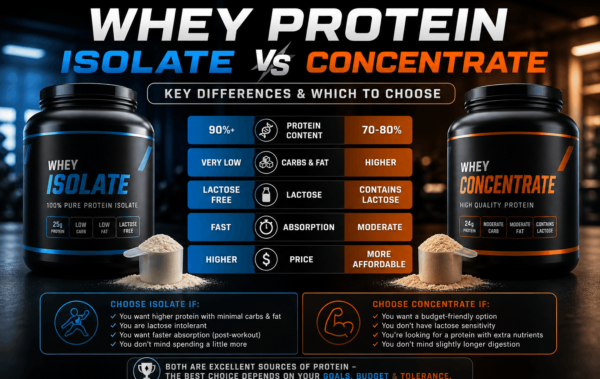
Whey Isolate
Isolate is whey that’s been processed further to remove most of the fat and lactose. Per gram, it delivers more protein and fewer carbs than concentrate. It’s also gentler on people who find regular whey causes bloating or digestive discomfort.
You’ll pay more for it. Whether that’s worth it depends on how sensitive your stomach is and how lean you want the formula to be. For a lot of people, the difference in day-to-day results between concentrate and isolate is minimal. But if lactose is an issue, isolate is an easy fix.
Casein
Casein digests slowly we’re talking six to eight hours for full absorption, compared to an hour or two for whey. That makes it a different tool for a different job. It’s not ideal right after a workout when you want fast delivery, but it’s useful before a long stretch without food, before bed, or as part of a meal when you want protein that actually keeps you full.
It’s thicker than whey almost pudding-like at higher concentrations which some people find satisfying and others find off-putting. If managing hunger is part of your goal, the satiety casein provides is real.
Plant-Based Blends
Plant proteins have come a long way. The early versions were chalky and nutritionally incomplete single-source options like plain pea protein or rice protein that lacked certain essential amino acids. The better products now combine two or three sources (pea plus rice is the most common) to cover those gaps, and texture has improved to the point where a good plant blend is genuinely comparable to whey for most people’s daily needs.
If you’re vegan, lactose intolerant, or just prefer to keep dairy out of your diet, a well-formulated plant blend is a real option, not a compromise. Single-source plant proteins are still worth avoiding unless you’re pairing them with other protein sources throughout the day.
Collagen
Collagen supplements are everywhere right now and the marketing is hard to ignore. Skin, hair, nails, joints the claims are broad. Collagen does have legitimate uses in those areas. What it can’t do is replace a complete protein for muscle building or recovery, because it’s missing several essential amino acids. Think of it as a supporting cast member, not a lead. If you want to add it alongside a complete protein, fine. But it shouldn’t be your primary source.
Matching the Powder to the Goal
Building Muscle
Muscle protein synthesis requires adequate leucine and a complete amino acid profile. Whey concentrate or isolate delivers both. So does a well-formulated plant blend. Aim for at least 20 grams of protein per serving, keep added sugar low, and make sure it’s something your digestion handles comfortably.
One thing worth knowing: mass gainers are mostly just protein powder plus a large dose of carbohydrates, often from maltodextrin or added sugar. For most people, eating real food carbs alongside a regular protein powder is a cleaner and more flexible approach.
Losing Weight or Managing Calories
Protein helps with weight management in two ways it preserves muscle during a calorie deficit and it keeps you fuller than carbs or fat per calorie. The powder for this goal should be high in protein relative to total calories, low in added sugar, and filling enough to actually take the edge off hunger.
Casein earns its place here because of how long it keeps you satiated. Whey isolate works well too lean formula, fast-digesting, and easy to track. Either way, ignore the front-of-pack claims and just check the protein-to-calorie ratio on the nutrition panel.
General Daily Use
Most people buying protein powder aren’t training for anything specific. They just want to eat more protein without cooking another meal or prepping more food. For that, convenience and consistency matter most.
A whey concentrate or lighter plant blend that tastes decent and mixes easily is usually enough. You don’t need the most optimized formula on the market you need something you’ll actually use on Tuesday morning when you’re running late.
Women-Specific Considerations
Most protein powders marketed specifically to women are standard formulas in different packaging. There’s no biological reason women need a fundamentally different protein powder than men. What does tend to matter more is digestibility, flavour, serving size, and whether it fits into how someone already eats.
A clean whey isolate or plant blend covers most goals. If a product is marketed toward women but has a shorter ingredient list and a reasonable serving size, that’s fine just know you’re buying the formula, not the branding.
Reading the Label: What to Focus On
Front-of-pack claims are marketing. The nutrition panel and ingredient list are where the product actually reveals itself. A few things worth checking:
- Protein source listed by name not buried in a proprietary blend
- Protein content per serving: 20 to 30 grams is the useful range for most people
- Added sugar: under 5 grams is reasonable; single digits at most
- Ingredient list length shorter generally means fewer unnecessary additives
- Third-party certification: NSF Certified for Sport or Informed Sport are the most credible
- Sweetener type if that matters to you stevia and monk fruit sit better with some people than sucralose or acesulfame potassium
Proprietary blends are a red flag. They list ingredients without disclosing individual amounts, which is usually a sign that something is underdosed. If a brand won’t tell you how much of each ingredient is in the product, that’s worth noting.
The Taste vs. Clean Ingredients Trade-Off
This tension is real and it’s not going away. Powders that taste like a chocolate shake almost always get there with extra sweeteners, thickeners, and flavour systems. Powders with short ingredient lists tend to taste more neutral fine blended into something, less exciting stirred into water.
Neither is wrong. If a powder that tastes great is the one you’ll actually drink every day, that’s the right choice for you. If you’d rather know exactly what you’re putting in your body and you’re mixing it into smoothies anyway, a simpler formula makes more sense. The only bad outcome is buying a clean protein that tastes like cardboard and abandoning it after a week.
Unflavored Protein: Underrated and Versatile
Unflavored protein doesn’t have much of a marketing story, which is probably why it gets overlooked. But if you cook with protein, add it to coffee, blend it into oatmeal, or regularly make smoothies where the fruit and other ingredients are doing the flavor work, unflavored is quietly one of the most practical options available.
The good versions dissolve cleanly, don’t leave a gritty residue, and taste like almost nothing meaning they won’t compete with whatever you’re adding them to. If you use protein powder in anything beyond a straight shake, it’s worth keeping a bag around.
What to Avoid
A few consistent warning signs show up across lower-quality products:
- Proprietary blends undisclosed amounts of each ingredient
- Added sugar above 5 to 8 grams per serving
- Padded ingredient lists with gums, artificial dyes, or fillers that add nothing
- Heavy metal contamination risk some plant proteins have tested poorly; third-party certification addresses this
- Dramatic claims about fat loss or muscle gain that aren’t backed by anything
If a product’s label spends more real estate on claims than on actual nutritional information, that’s a good sign the formula isn’t strong enough to sell itself.
How Much Protein Powder Do You Actually Need?
Probably less than you think. Protein powder fills a gap it’s not a meal replacement or a magic lever. If your whole food diet is already solid and you’re hitting your protein targets, you might not need it at all.
Where it earns its keep: busy mornings when cooking isn’t happening, right after training when you want something fast, or stretches in the day when hunger tends to push people toward the wrong choices. One scoop 20 to 30 grams of protein is where most people land. More than that in a single sitting isn’t doing extra work; your body processes protein most efficiently in moderate doses spread throughout the day.
Conclusion, Which One Should You Buy?
Whey concentrate or isolate covers the most ground for the most people. Simple ingredient list, complete amino acid profile, good research backing, and enough variety in the market that you can find one that tastes acceptable without compromising on ingredients.
Avoiding dairy? A pea-and-rice blend from a brand that’s been third-party tested is a solid alternative. Focused on satiety? Casein deserves a look. Cooking with protein regularly? Grab an unflavored option alongside whatever flavored powder you’re already using.
The questions actually worth asking before you buy:
- What’s the goal muscle, weight management, or just convenience?
- Any dietary restrictions dairy, gluten, vegan?
- Where will I use it shakes only, or in food as well?
- Does taste matter a lot to me, or is ingredient simplicity the priority?
- Has this brand been independently tested?
Answer those and most of the noise disappears. The best protein powder isn’t the one with the most dramatic claims or the most Instagram presence. It’s the one that fits how you actually eat and doesn’t give you a reason to stop using it.