No products in the cart.
So you’ve decided to add whey protein to your routine. Smart move. But then you get to the store or worse, you open Amazon and suddenly there are seventeen options and half of them say “isolate” and the other half say “concentrate” and nobody’s explaining why it matters.
Let’s fix that.
What Is Whey Protein?
Milk, when processed into cheese, separates into two components. The solid portion becomes casein. The liquid that drains off is whey and that liquid, once filtered and dried, is what ends up in your protein powder.
Technically speaking, whey is a complete protein source. It contains all nine essential amino acids, has a high biological value, and is rapidly absorbed post-ingestion which is why sports scientists have studied it extensively since the 1990s.
People use it for muscle growth, recovery acceleration, and hitting daily protein targets when whole food intake falls short.
The two forms you’ll actually encounter are concentrate and isolate. Same starting material. Different endpoints.
Concentrate: The One Most People Start With
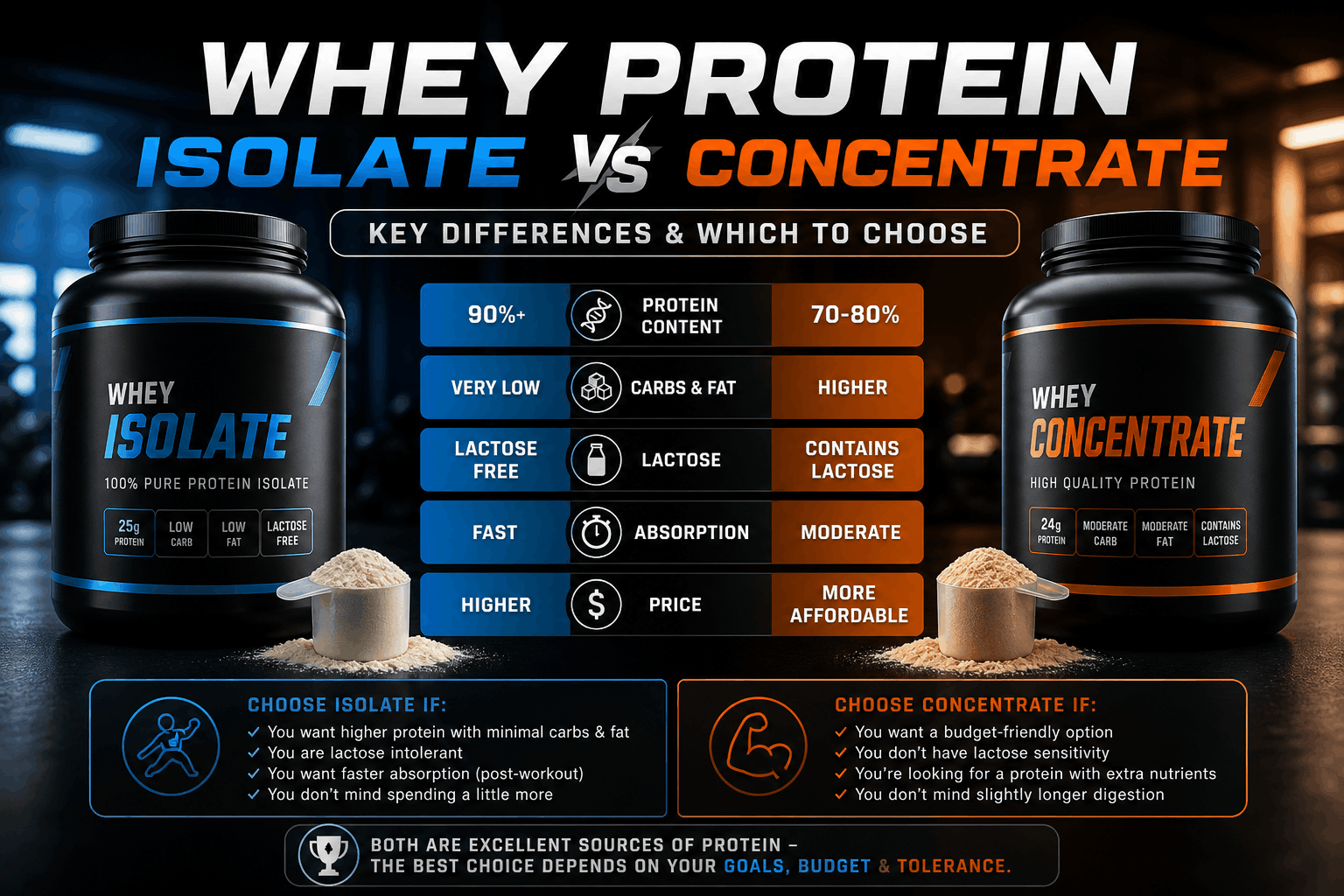
Whey concentrate goes through filtration, but not a lot of it. What comes out the other side is a powder with roughly 70–80% protein content the rest being small amounts of lactose, fat, and naturally occurring minerals.
The most widely sold grade is WPC 80. If your tub just says “whey protein” and doesn’t specify isolate, there’s a good chance this is what’s inside.
Taste-wise? It’s the better option. That’s not subjective marketing fluff the fat content genuinely contributes to a creamier, more rounded flavor profile. A lot of the protein powders people describe as “actually drinkable” are concentrate-based.
It’s also easier on the wallet. And if you’re buying protein every single month, that price gap matters more than people admit.
Lactose
The one real issue: lactose. Concentrate retains enough of it that people with dairy sensitivities can run into bloating and digestive discomfort. It doesn’t affect everyone. But if it affects you, you’ll know pretty fast.
Isolate: More Processed, More Precise
Here’s where the chemistry gets a bit more involved.
Whey isolate undergoes additional filtration steps typically microfiltration or ion exchange that strip out the majority of lactose, fat, and carbohydrates. What remains is a product with 90% or higher protein content per serving.
That’s not a small difference. Per 30g scoop, you might be getting 27–28g of protein from isolate versus 22–24g from concentrate. Over weeks of consistent use, that gap compounds.
Isolate is also significantly lower in calories and carbohydrates, which makes it a natural fit for calorie-restricted phases. And the near-absence of lactose means most people who’d normally struggle with dairy tolerate it without issues.
Downsides
The downside is price isolate costs noticeably more than concentrate. And texture-wise, it tends to be thinner and less satisfying to drink.
Some people honestly don’t care. Others find it a dealbreaker.
Okay But Which One Is Actually Better
Neither. That’s the honest answer and most supplement brands don’t want to say it. Both forms deliver complete amino acids. Both support muscle protein synthesis. The research on muscle gain outcomes doesn’t show meaningful differences between isolate and concentrate users when total protein intake is matched. Your body isn’t keeping score on processing method.
What the difference does affect is everything around the protein itself calories, digestion, cost, texture. Those things matter depending on who you are and what you’re trying to do.
Breaking Down the Comparison
Protein per gram
Isolate is denser. 90%+ versus 70–80% for concentrate. Simple math more protein per scoop.
Lactose content
Isolate has almost none. Concentrate has more, which is fine for most people and a problem for some. If you’ve ever had a bad experience with dairy-based products, this is the factor to pay attention to.
Calories and macros
Isolate is leaner. Lower fat, lower carbs, lower total calorie count. If you’re tracking macros down to the gram, this matters. If you’re not, it probably doesn’t.
Taste
Concentrate wins. The fat gives it body and flavor. Isolate is cleaner-tasting but thinner.
Nutrient profile
Because concentrate is less processed, it holds onto more naturally occurring compounds certain minerals, some bioactive peptides. Not dramatic, but real. Isolate loses some of that in filtration.
Price
Concentrate is meaningfully cheaper. Not slightly cheaper often a significant difference per kilogram.
What Your Goal Actually Has to Do With This
For muscle building, the concentrate vs isolate debate is mostly noise. Get your protein in, hit your training, sleep enough. The form of whey you’re using isn’t the variable that’s going to determine your results. Fat loss is different. When you’re in a calorie deficit, every macro counts. Isolate gives you more protein for fewer calories and that’s genuinely useful when you’re trying to stay full while staying lean.
Lactose intolerance changes everything. If you’re someone who deals with digestive issues around dairy, isolate is the practical answer. A lot of people who gave up on protein powders entirely because of stomach problems have gone back to isolate without any trouble.
Budget is a real factor. Some fitness circles treat price as a secondary concern, but if you’re a working person spending money on supplements every month, the difference between a concentrate and an isolate of similar quality can add up to a meaningful sum over a year.
The “Whey Protein vs Whey Isolate” Thing
This comparison gets searched constantly, and it’s built on a slight misunderstanding. Whey isolate is whey protein. It’s a subcategory, not a competitor. When people search “whey protein vs whey isolate,” what they’re usually actually asking is concentrate vs isolate they just don’t know the terminology yet.
So if you’ve been thinking of them as two separate product types, they’re not. Same origin, different processing levels, different outputs.
Choosing Between Them
Questions
Are you managing calories closely? Isolate fits cleaner into restrictive macros.
Does dairy give you any trouble? Isolate is the safer bet. Are you training generally with no specific dietary phase? Concentrate is solid. No real reason to pay more.
How often are you buying protein? If it’s monthly, the cumulative price difference between isolate and concentrate is worth calculating before defaulting to the more expensive option.
Ingredient Check
Also check the full ingredient list, not just the protein content. Some powders include creatine, caffeine, or digestive enzymes that affect your experience. Some use artificial sweeteners that people react differently to. The protein percentage is just one number on a more complicated label.
Final Thought
The isolate vs concentrate question doesn’t have a single correct answer. What it has is a correct answer for your situation.If you want precision more protein, fewer calories, easier digestion isolate is worth the extra cost.
If you want value, better taste, and a product that works reliably concentrate does the job. Both are legitimate. Both get results. The part that actually matters is consistency: taking your protein regularly, eating well around it, and not spending more mental energy on the isolate vs concentrate debate than it deserves. Pick one. Use it. Adjust if it’s not working.